

Showing posts with label LPI. Show all posts
Showing posts with label LPI. Show all posts
Tuesday, October 21, 2014

Tuesday, August 26, 2014
STA Adds Collins Propane Powered Buses

Collins serves as the largest producer of Type-A buses in North America and leads the industry with alternative fuel options that meet the needs of their diverse customer base. The NexBus is built on a dual rear wheel GM chassis and is powered by a Liquid Propane Injection system by CleanFUEL USA. The product exhibits excellent cold weather starting, has an estimated range in excess of 300 miles, and is available in capacities up to 32 passengers.
Propane autogas is the third most widely used transportation fuel globally, behind gasoline and diesel, and is proven to be a more attractive option from an economic and environmental standpoint.
"We continue to add propane powered vehicles to our fleet thanks to the multiple advantages the fuel offers and we look forward to a long term relationship, including the suburb maintenance support offered by Collins Bus Corporation," says Denis Gallagher, CEO of parent company Student Transportation Inc. The buses are part of a large commitment by STA, which includes several additional states and hundreds of propane autogas buses.
Friday, August 22, 2014
PROPANE INDUSTRY UNVEILS NEW BRAND, TAGLINE: PROPANE CLEAN AMERICAN ENERGY™

The logo, anchored by the iconic image of an American bald eagle, highlights propane as an increasingly American-made alternative fuel at a time when U.S. propane production from natural gas liquids is at record levels. According to PERC President and CEO Roy Willis, the change also emphasizes recent investments by the propane industry in new technologies, including propane-powered vehicles, school buses, mowers, irrigation engines, and other equipment.
“We hope PROPANE Clean American Energy™ will increase consideration of propane as a clean, affordable, and American-made alternative to conventional fuels among fleets, commercial landscapers, contractors, producers, and homeowners,” Willis says. “Increasing domestic demand for propane in the U.S. will ultimately lead to cleaner air and increased use of our nation's own energy resources, rather than relying on foreign oil.”
The propane industry began working on the research and branding project at the beginning of 2013. The new logo and tagline will be used in all PERC-produced materials and will be made available free of charge to propane providers and OEM partners, such as Roush CleanTech, Exmark, and Kohler. The new logo will also replace the previous mark used by thousands of propane retailers nationwide on signs, delivery vehicles, equipment, websites, and literature.
The PROPANE Clean American Energy™ logo will be prominently featured in PERC’s new multimedia safety campaign designed to encourage residential propane heating customers and agribusiness operators, among others, to fill up in advance of the winter season and make arrangements with propane providers to keep tanks full. The campaign begins Sept. 8. More information is available at propanecomfort.com.
“America makes more than enough propane to meet U.S. demand,” Willis says. “As PERC rolls out this important safety campaign and new branding identity, the propane industry is prepared to meet the needs of a changing energy economy.”
S2G Factory Tour
The Freightliner Custom Chassis S2G is the only medium duty truck that includes a factory-installed propane system. Watch the video below or click here for an awesome inside view of the S2G factory line in Gaffney, South Carolina.
Thursday, August 14, 2014
Amphi school buses are going 'green'

According to officials with the district some 6,000 students ride to school on the bus and soon some will get to take a green one to campus, but they aren't talking new paint color. These newer buses will run on cleaner fuel than diesel. This week the district received two new buses that are fueled by propane. The new propane powered buses also run quieter than conventional diesel powered buses.
The new propane buses are not quite ready for service yet, so they will not be picking up and dropping off students. Officials with Amphi are saying these two new buses are just the beginning, the plan is to replace 15 diesel buses with propane ones. This changeover will save the district on fuel, propane costs fifty percent less than diesel, a change that will save the district some $75,000 in fuel cost for the year. Fuel savings will go back into the general fund, said Amphi officials, which means more money for the classroom. Aside from more money for the classroom, there is another benefit to propane, it is produced domestically.
"This means less dependency on foreign oil," said Marc Lappitt, Director of Transportation for the Amphi Public Schools. "All the propane that we consume is domestically produced in the U.S."
Students will find it difficult to see the difference between the diesel and the propane powered buses, but they certainly will feel it temperature wise. The air conditioning works better in the propane buses.
District officials are expecting three more propane buses next week, with the ultimate goal of getting them all in service by August 18. See original article here.
The new propane buses are not quite ready for service yet, so they will not be picking up and dropping off students. Officials with Amphi are saying these two new buses are just the beginning, the plan is to replace 15 diesel buses with propane ones. This changeover will save the district on fuel, propane costs fifty percent less than diesel, a change that will save the district some $75,000 in fuel cost for the year. Fuel savings will go back into the general fund, said Amphi officials, which means more money for the classroom. Aside from more money for the classroom, there is another benefit to propane, it is produced domestically.
"This means less dependency on foreign oil," said Marc Lappitt, Director of Transportation for the Amphi Public Schools. "All the propane that we consume is domestically produced in the U.S."
Students will find it difficult to see the difference between the diesel and the propane powered buses, but they certainly will feel it temperature wise. The air conditioning works better in the propane buses.
District officials are expecting three more propane buses next week, with the ultimate goal of getting them all in service by August 18. See original article here.
Thursday, August 7, 2014
BPN: Propane Bobtail Hits Production Milestone
 June 16 marked a major milestone for the propane industry as the Freightliner Custom Chassis Corp. (FCCC; Gaffney, S.C.) S2G propane-fueled bobtail went into full production. FCCC is taking orders now, and about 25 trucks had been delivered as of late June. Initial reviews have been positive, but as is the case with most products, the process has not been glitch-free. The Burton, Mich. location of AmeriGas, which is using the truck on a pilot project basis, has given the truck high marks, although it experienced some low-idling problems with the bobtail early on. FCCC, however, fixed that problem quickly, said AmeriGas area director Mike George.
He told BPN the reduced cost of operation has been the truck’s biggest advantage. That is especially the case in the summer months when the price of propane is lower.
“You’re looking at almost a 50%-per-gallon difference to operate the truck,” George stated. “That’s the big ‘wow’ factor. It’s a cleaner-burning product, so I don’t expect to have as high maintenance costs with the vehicle.”
A participant at a ride and drive during last year’s National Truck Equipment Association Work Truck Show commented, “Quiet, really quiet. I’m really pleasantly surprised. It drives like a car. Minimum cab noise. You wouldn’t even know you’re driving a truck.”
Although some marketers were still apprehensive about ordering at this early stage and were taking a “wait-and-see” attitude, the many positive comments must be gratifying for all the companies involved with putting together the bobtail. FCCC built the vehicle chassis, Powertrain Integration (Madison Heights, Mich.) produced the engine, and CleanFUEL USA (Georgetown, Texas) designed the fuel tank system assembly and the fuel rail system assembly.
It might seem like it has been a long road to get to this point, but Bryan Henke of FCCC notes that the process has not been much different than that of any original equipment manufacturer (OEM) product. OEMs typically start manufacturing products by unveiling pilot units to test how they will run through the production line. That took place about a year ago for the S2G. Then comes “pre-series,” a limited production run to make sure the production process is working as planned. That took place around March of this year.
Now that the product is in full production, Henke says FCCC as of late June had several hundred orders, which were spread fairly evenly around the country. Propane marketers can order the bobtail from any of about 600 U.S. FCCC dealers.
The S2G will not just be available as a bobtail, however. Production is underway now for the bobtail, but the unit will go into production around the first quarter of 2015 for crane truck and box truck configurations as well. The chassis is also made for the Thomas Built Bus Co., and the school bus chassis using the same propane fueling system is also in full production.
Also like any OEM project, the S2G went through extensive testing to get to this point. FCCC built the pre-series units specifically for in-field testing. The company put the vehicle through several hundred thousand miles of durability testing, altitude testing on the rugged terrain of the Rocky Mountrains, including Pikes Peak, in Colorado, and cold start testing in –30ºF temperatures and colder in Bemidji, Minn.
“This is very typical of how we want to validate a vehicle’s design,” Henke explained.
Dealer buy-in is also important in any OEM product release, and Henke stressed that the FCCC dealers understand the features of the bobtail. They know alternative fuels because the company has been involved with natural gas products. The company showed the vehicle at an FCCC event in Wisconsin in June, and gatherings like that have achieved good results. A recent Southern Connecticut FCCC S2G event resulted in the sale of several trucks.
“The FCCC dealers are energized,” he said. “They’re seeing results with the trucks and getting more engaged with it.”
It’s been a long road since General Motors phased out its 8.1L engine from the medium-duty truck market at the end of 2009. Tucker Perkins, chief business development officer of the Propane Education & Research Council (PERC), recalled that the phase-out took place during the heart of the U.S. financial crisis that resulted in the government’s bailout of GM. The automaker had a buyer for its medium-duty truck division, but the deal fell through. Perkins, who was with CleanFUEL USA at the time, described GM’s medium-duty truck program as “successful by any stretch of the imagination.” Sales of the propane version of the 8.1L were just beginning to grow, and many users were satisfied with the propane-fueled bobtail. After GM’s exit from that market, PERC, CleanFUEL USA, and Blue Bird Bus bought GM’s remaining inventory of 8.1L engines to continue the Blue Bird propane school bus program.
The S2G will not just be available as a bobtail, however. Production is underway now for the bobtail, but the unit will go into production around the first quarter of 2015 for crane truck and box truck configurations as well. The chassis is also made for the Thomas Built Bus Co., and the school bus chassis using the same propane fueling system is also in full production.
Also like any OEM project, the S2G went through extensive testing to get to this point. FCCC built the pre-series units specifically for in-field testing. The company put the vehicle through several hundred thousand miles of durability testing, altitude testing on the rugged terrain of the Rocky Mountrains, including Pikes Peak, in Colorado, and cold start testing in –30ºF temperatures and colder in Bemidji, Minn.
“This is very typical of how we want to validate a vehicle’s design,” Henke explained.
Dealer buy-in is also important in any OEM product release, and Henke stressed that the FCCC dealers understand the features of the bobtail. They know alternative fuels because the company has been involved with natural gas products. The company showed the vehicle at an FCCC event in Wisconsin in June, and gatherings like that have achieved good results. A recent Southern Connecticut FCCC S2G event resulted in the sale of several trucks.
“The FCCC dealers are energized,” he said. “They’re seeing results with the trucks and getting more engaged with it.”
It’s been a long road since General Motors phased out its 8.1L engine from the medium-duty truck market at the end of 2009. Tucker Perkins, chief business development officer of the Propane Education & Research Council (PERC), recalled that the phase-out took place during the heart of the U.S. financial crisis that resulted in the government’s bailout of GM. The automaker had a buyer for its medium-duty truck division, but the deal fell through. Perkins, who was with CleanFUEL USA at the time, described GM’s medium-duty truck program as “successful by any stretch of the imagination.” Sales of the propane version of the 8.1L were just beginning to grow, and many users were satisfied with the propane-fueled bobtail. After GM’s exit from that market, PERC, CleanFUEL USA, and Blue Bird Bus bought GM’s remaining inventory of 8.1L engines to continue the Blue Bird propane school bus program.
 CleanFUEL USA and Powertrain Integration immediately began working on a brand new engine, which is an 8.0L to replace the 8.1L and features more horsepower, torque, and fuel efficiency along with lower emissions. The engine has gone through various changes since the original pilot version.
“It’s amazing how the vehicle integration from the fuel system to the engine itself, to noise, to air intake, to just about everything, has evolved over the past several years,” Henke noted. “If you would have looked at the pilot unit we did several years ago and what we have today, there are significant changes, because we just weren’t satisfied with the status quo.”
The ability to start the vehicle in extreme cold weather was a big area of focus for the S2G. According to Henke, cold-start was an issue for liquid injection systems when he worked for a company that sold vaporized systems. But he and his team were pleasantly surprised when they heard that the S2G had no trouble starting in –30°F and colder temperatures in Bemidji.
“I thought, really, we’re getting cold-start without a block heater? We are. That’s unheard of,” Henke stated.
The S2G team also paid close attention to noise. The group worked to make sure the vehicle would be quiet for the driver and for residential customers’ neighbors.
“It wasn’t just making sure it ran right,” Henke said. “Propane marketers remember the past. They have great memories. We certainly did not want to have issues that these guys had in the past 10 to 20 years ago.”
Along with stringent testing in areas such as noise, starting, and cooling, additional durability testing involved running the vehicle continuously around the clock. That testing revealed some mostly minor mechanical issues that the team addressed. In mid-December, Perkins told BPN that the team resolved a few technical issues in areas such as engine calibration and oil leaks.
“In some cases they were minor nuisances in our opinion, but not acceptable,” Henke noted. “Maybe for some other applications, a little leak here or there or a little noise rattle here or there after 60,000 or 100,000 miles might be acceptable, but it really wasn’t to us. So we wanted to make sure that we shook this vehicle down. I think we’ve accomplished that.”
Meanwhile, FCCC is working on marketing the product to potential users and educating its own dealers. “We’re letting FCCC dealers know the product is in full production, because they’ve been waiting quite a long time,” Henke explained. The company will hold a special event in Gaffney in late summer so potential buyers can get hands-on experience with the truck.
Many marketers are ready now. Trevor Beaudry, propane manager for Beaudry Oil (Elk River, Minn.), said his company has one S2G on order and was set to receive it in August or September.
“We decided to order one for the fuel savings and to support propane for motor fuel use,” Beaudry said. “We think if it is successful then there will be opportunity for the vehicle in different industries.”
McMahon’s Bottle Gas (Dayton, Ohio) has not ordered the S2G yet, but plans on doing so next year. “We really want a propane bobtail, but we wanted to give them a year to work out the bugs,” said Brian Buschur of McMahons.
Other marketers are on the fence. “We have considered ordering one, but were not sure how long we would have to wait to get it,” said Daren Parker of Parker Gas Co. (Newton Grove, N.C.). “I am still not sure when the first ones will be available. I have not test driven one. I obviously would like to see this thing work out, but am kind of skeptical about being the guinea pig.”
The truck won’t be for everyone, of course. Kevin Lechner of Lechner’s Propane (East Branch, N.Y.) test drove the vehicle at a recent Ray Murray Inc. open house in Lee, Mass. Although he said using a propane-fueled bobtail would lower his operating costs, he would not order one because his location is in a mountainous area.
“The automatic transmission is constantly shifting, so in my location, it’s not so much of a ‘pro’ for me,” said Lechner, addressing the pros and cons. He now prefers diesel-fueled bobtails with standard transmissions because they can be more easily fitted with a “Jake brake” that uses engine compression to slow down the vehicle so the driver does not have to pump the brakes as much while traveling downhill. Read more here.
Monday, July 21, 2014
Freightliner Custom Chassis Corp. Releases 24/7 Direct Customer-Service App

The 24/7 Direct app from FCCC made its debut in Apple’s App Store for the iOS mobile operating system this week, joining recently released versions of the app for Android and Windows Phone. The 24/7 Direct app, which is available free of charge, makes FCCC customer service available 24 hours a day, seven days a week by putting the entirety of the FCCC dealer and service network in the palm of users’ hands. The app is designed for customers riding on RV, walk-in van, and commercial bus chassis.
“We design and build products made for people who love spending time on the road, which means the need to locate and connect with a dealer or service center can happen anywhere,” said Bryan Henke, manager of product marketing for FCCC. “When we say we’re ‘Driven by You,’ we mean it. And a big part of that drive is providing the best and most comprehensive support network we can. The 24/7 Direct app makes that network even more accessible and effective for our customers.”
The location-based app uses GPS coordinates to provide customers with information on the closest dealers within a set distance, from as close as 25 miles up to 250 miles. App users can then connect easily with an individual dealership via phone or email; users can also connect with FCCC directly via phone or email via the app.
The 24/7 Direct app is the first customer-focused app from FCCC; it released a dealer- and service-focused app, SalesHQ, in 2013. To download 24/7 Direct, search for “24/7 Direct” or “FCCC” in the app stores for Apple, Android and Windows Phone.
Freightliner Custom Chassis Corporation manufactures premium chassis for the motorhome, delivery walk-in van, and school bus and shuttle bus markets. Visit the Freightliner Custom Chassis Corporation website at www.freightlinerchassis.com for additional FCCC news and product information. Freightliner Custom Chassis Corporation is a subsidiary of Daimler Trucks North America LLC, a Daimler company. Read more here.
Wednesday, July 16, 2014
CleanFUEL USA Meets Fleet Industry Demand with New Products in Full Production
Company’s
Liquid Propane Injection System Powers Freightliner
Custom Chassis S2G Medium-Duty Truck and Thomas Built C2 School Bus

GEORGETOWN, TX –– July 16, 2014 – CleanFUEL USA, the industry leader in propane autogas fleets and fueling infrastructure, today announced full production of two prominent product offerings powered by its Liquid Propane Injection (LPI) system, the Freightliner Custom Chassis S2G medium-duty truck and the Thomas Built C2 school bus. The CleanFUEL USA LPI propane autogas fuel system is technologically advanced, fully integrated and factory-installed, requiring no aftermarket modifications, for seamless integration and consistent quality. Both vehicles are EPA and CARB certified.
“We are ecstatic that the S2G and C2 are in full production, as demand is strong in the fleet industry for propane-powered solutions that meet these two vehicles’ market needs,” said Curtis Donaldson, founder and managing director of CleanFUEL USA. “With a significant order bank and ever-increasing customer interest, the potential for both products is huge.”
The S2G truck pairs FCCC’s popular S2 chassis with the only factory-installed propane autogas engine available to the medium-duty truck market. The FCCC S2G was designed with input from fleet managers and body manufacturers on component placement, PTO accessibility and electrical interfaces.
The Thomas Built Saf-T-Liner C2 school bus offers exceptional power and quiet operation, and is available with popular options like wheelchair lifts and air-conditioning. Today, one in three American children who ride a bus to school or an activity rides a Thomas.
Both products are powered by an 8-liter purpose-built engine by Powertrain Integration and an Allison 2300 automatic transmission with PTO provision, providing reliability and durability. The engine offers 495 ft-lbs of torque at 3100 rpm and 339 horsepower at 4100 rpm, and both are backed by warranties and service programs.
More information on the S2G can be found here and the C2 here.
About CleanFUEL USA:
CleanFUEL
USA, the nation’s first developer of liquid propane fuel injection systems, is
a leading manufacturer of propane autogas dispensers and refueling
infrastructure. Headquartered in Georgetown, Texas, with an engineering
division in Wixom, Mich., CleanFUEL USA celebrates more than 20 years of
innovation. Setting industry standards with a complete alternative fuel
solution, CleanFUEL USA products offer unsurpassed economic and environmental
advantages. Learn more at www.cleanfuelusa.com.
Connect on Twitter (@CleanFUELUSA), Facebook (facebook.com/CleanFUELUSA), YouTube (youtube.com/CleanFuelUSA1) and LinkedIn
(linkedin.com/company/cleanfuel-usa).
###
Contacts
Gina Manassero
(512) 553-2387
Crystelle
Markley
CleanFUEL USA
(512) 864-0300
Tuesday, July 15, 2014

Monday, July 14, 2014


Friday, July 11, 2014


Monday, June 30, 2014
Friday, June 20, 2014
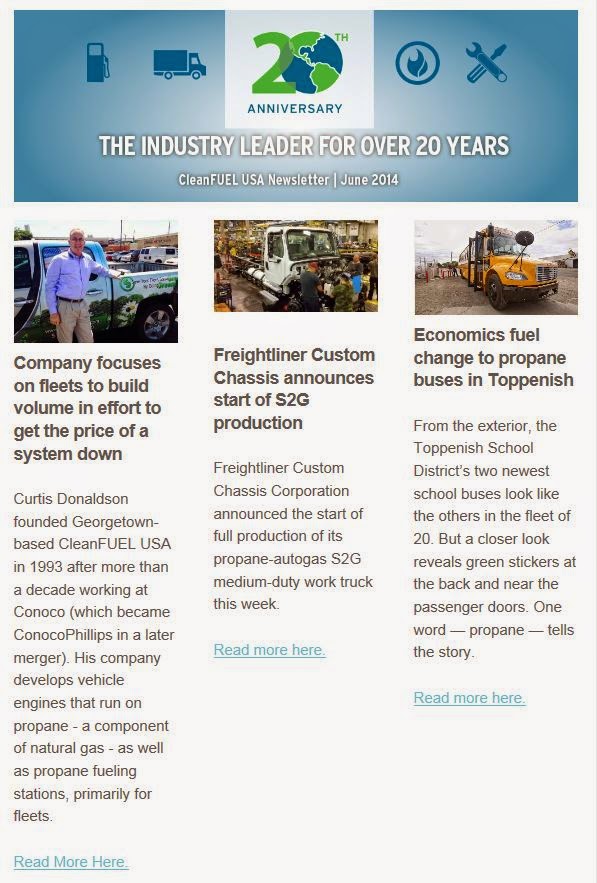
Freightliner Custom Chassis announces start of S2G production
Freightliner Custom Chassis
Corporation announced the start of full production of its propane-autogas S2G
medium-duty work truck this week. The S2G pairs FCCC’s popular, durable S2
chassis with the only factory-installed propane autogas engine available for
the medium-duty truck market. The S2G is powered by an 8-liter V8 “big block”
engine - featuring a CleanFUEL USA Liquid Propane Injection system - offering up 339hp
and 495 ft-lbs of torque. Initial orders for the truck will focus on the
propane-delivery market; FCCC has plans to expand into other applications and
industries beginning in 2015. For more information, visit S2Gtruck.com.

Subscribe to:
Posts (Atom)