 |
| Click here to read our August newsletter! |

Showing posts with label school bus. Show all posts
Showing posts with label school bus. Show all posts
Tuesday, September 2, 2014

Monday, September 1, 2014
An inside look at the 8L engine
Hear from Powertrain Integration's Robert Roehl talking about the new PIthon propane engine built exclusively for the Thomas Built Buses Saf-T-Liner C2 and Freightliner Custom Chassis S2G. The companies displayed the engine and bus at the STN EXPO in Reno.
Wednesday, August 27, 2014
Third Thursday Webinar to feature Thomas Built Buses

September 18th at 10am (CST)
Come hear more about why the propane autogas C2 is an excellent choice for your fleet!
As district budgets are tightened and environmental standards become as much of a public mandate as they are governmental, fleets are switching to alternative-fueled school buses to improve their image and their transportation budget. Thomas Built Buses is excited to expand their alternative fuel offering with its propane-fueled Saf-T-Liner C2 school bus, now in full production.
Built upon the popular Saf-T-Liner C2 model, the propane-fueled C2 provides outstanding maneuverability, state-of-the-art driver ergonomics and the greatest visibility among all Type C buses - with zero sacrifices in style, performance, safety or comfort. Under the hood, the propane-fueled C2 comes complete with an Allison 2300 PTS Series transmission, an 8.0 liter engine provided by Powertrain Integration and a fully-integrated CleanFUEL USA Liquid Propane Injection fuel system.
Tuesday, August 26, 2014
STA Adds Collins Propane Powered Buses

Collins serves as the largest producer of Type-A buses in North America and leads the industry with alternative fuel options that meet the needs of their diverse customer base. The NexBus is built on a dual rear wheel GM chassis and is powered by a Liquid Propane Injection system by CleanFUEL USA. The product exhibits excellent cold weather starting, has an estimated range in excess of 300 miles, and is available in capacities up to 32 passengers.
Propane autogas is the third most widely used transportation fuel globally, behind gasoline and diesel, and is proven to be a more attractive option from an economic and environmental standpoint.
"We continue to add propane powered vehicles to our fleet thanks to the multiple advantages the fuel offers and we look forward to a long term relationship, including the suburb maintenance support offered by Collins Bus Corporation," says Denis Gallagher, CEO of parent company Student Transportation Inc. The buses are part of a large commitment by STA, which includes several additional states and hundreds of propane autogas buses.
Tuesday, August 19, 2014
Virtual Tour: Collins Bus plant
Click here to take a spin through Collins Bus Corp.’s South Hutchinson, Kansas, facility to get a glimpse of how the company's Type A school buses are built and tested.


Thursday, August 14, 2014
Amphi school buses are going 'green'

According to officials with the district some 6,000 students ride to school on the bus and soon some will get to take a green one to campus, but they aren't talking new paint color. These newer buses will run on cleaner fuel than diesel. This week the district received two new buses that are fueled by propane. The new propane powered buses also run quieter than conventional diesel powered buses.
The new propane buses are not quite ready for service yet, so they will not be picking up and dropping off students. Officials with Amphi are saying these two new buses are just the beginning, the plan is to replace 15 diesel buses with propane ones. This changeover will save the district on fuel, propane costs fifty percent less than diesel, a change that will save the district some $75,000 in fuel cost for the year. Fuel savings will go back into the general fund, said Amphi officials, which means more money for the classroom. Aside from more money for the classroom, there is another benefit to propane, it is produced domestically.
"This means less dependency on foreign oil," said Marc Lappitt, Director of Transportation for the Amphi Public Schools. "All the propane that we consume is domestically produced in the U.S."
Students will find it difficult to see the difference between the diesel and the propane powered buses, but they certainly will feel it temperature wise. The air conditioning works better in the propane buses.
District officials are expecting three more propane buses next week, with the ultimate goal of getting them all in service by August 18. See original article here.
Tuesday, August 12, 2014
Thomas Built Bus Report: Propane buses? What's all of the fuss about?
 |
|||
|
|
|||
|
|
|
||
|
|
|||
|
|
 |
|
There has been a lot
of buzz surrounding propane buses, but what is all of the fuss about? Hasn't
propane been around for years?
It's true that propane is not a
new fuel source, but its popularity in the school bus industry is definitely
on the rise. As district budgets are tightened and environmental standards
become as much of a public mandate as they are governmental, fleets are
switching to alternative-fueled school buses to improve their image and their
transportation budgets. Alternative fuels, such as CNG and propane, are
"green" fuels that are less impactful on the environment and are
cheaper, more efficient fuel sources.
But why propane?
There are many advantages to propane-fueled school buses, starting with the fact that propane is simply the world's most popular clean-burning alternative fuel. Propane has been used for many things, from grilling steaks to heating homes, so most people are at least somewhat familiar with propane. |
|
|
|||
|
|
|||
|
|
|||
|
|
 |
|
To celebrate riding
the school bus back to school, Thomas Built Buses is once again hosting its
annual Back to School Photo Contest. The photo contest invites parents to
submit a photo of their child that best represents the Back to School season.
The top five winners
will each receive a $2,000 donation for their child's school.
To enter, parents and students
aged 18 or older can visit the Thomas Built Buses Facebook page,
"Like" the page and enter a photo that best represents the fun,
excitement and nostalgia of riding the bus back to school to either
elementary, middle, or high school. All photos must depict a school bus.
Entries will be accepted from
August 1, 2014 through September 15, 2014.
To learn more, visit www.Thomasbus.com/contest > |
|
|
|||
|
|
|||
|
|
|||
|
|
 |
|
HIGH POINT, N.C. —
Thomas Built Buses announced on Wednesday that it will extend its standard
warranty coverage for the Saf-T-Liner C2 as well as its warranty coverage for
standard body and chassis paint on all models.
The Saf-T-Liner C2 base warranty
will provide three-year or 50,000-mile coverage for units built on or after
Oct. 1, 2014. This is an extension over the previous one-year warranty. The
warranty will cover the chassis and many other components, including
electrical and manual controls, safety equipment, assemblies and more. Normal
wear items are excluded.
|
|
|
|||
|
|
 Total Cost of Ownership Pro
Tip |
||
|
|
|||
|
|
 |
|
Train your
team; time is running out
Downtime is costly. Technician
training is an important aspect of TCO because the sooner your technicians
can perform routine maintenance checks, the more quickly your buses can be
back on the road. Solid training keeps your buses in optimal condition, and
it saves you time and money on maintenance that can be performed quickly
on-site.
Each year, Thomas Built Buses
offers hands-on intensive technician training and factory-certified curriculum
all in one week. Thomas Built Institute 2014 - West will take place from
September 9 - 12 in Dallas, Texas. Registration is now open.
To register or learn more, visit
the Thomas Built Institute page.
|
Wednesday, July 16, 2014
CleanFUEL USA Meets Fleet Industry Demand with New Products in Full Production
Company’s
Liquid Propane Injection System Powers Freightliner
Custom Chassis S2G Medium-Duty Truck and Thomas Built C2 School Bus

GEORGETOWN, TX –– July 16, 2014 – CleanFUEL USA, the industry leader in propane autogas fleets and fueling infrastructure, today announced full production of two prominent product offerings powered by its Liquid Propane Injection (LPI) system, the Freightliner Custom Chassis S2G medium-duty truck and the Thomas Built C2 school bus. The CleanFUEL USA LPI propane autogas fuel system is technologically advanced, fully integrated and factory-installed, requiring no aftermarket modifications, for seamless integration and consistent quality. Both vehicles are EPA and CARB certified.
“We are ecstatic that the S2G and C2 are in full production, as demand is strong in the fleet industry for propane-powered solutions that meet these two vehicles’ market needs,” said Curtis Donaldson, founder and managing director of CleanFUEL USA. “With a significant order bank and ever-increasing customer interest, the potential for both products is huge.”
The S2G truck pairs FCCC’s popular S2 chassis with the only factory-installed propane autogas engine available to the medium-duty truck market. The FCCC S2G was designed with input from fleet managers and body manufacturers on component placement, PTO accessibility and electrical interfaces.
The Thomas Built Saf-T-Liner C2 school bus offers exceptional power and quiet operation, and is available with popular options like wheelchair lifts and air-conditioning. Today, one in three American children who ride a bus to school or an activity rides a Thomas.
Both products are powered by an 8-liter purpose-built engine by Powertrain Integration and an Allison 2300 automatic transmission with PTO provision, providing reliability and durability. The engine offers 495 ft-lbs of torque at 3100 rpm and 339 horsepower at 4100 rpm, and both are backed by warranties and service programs.
More information on the S2G can be found here and the C2 here.
About CleanFUEL USA:
CleanFUEL
USA, the nation’s first developer of liquid propane fuel injection systems, is
a leading manufacturer of propane autogas dispensers and refueling
infrastructure. Headquartered in Georgetown, Texas, with an engineering
division in Wixom, Mich., CleanFUEL USA celebrates more than 20 years of
innovation. Setting industry standards with a complete alternative fuel
solution, CleanFUEL USA products offer unsurpassed economic and environmental
advantages. Learn more at www.cleanfuelusa.com.
Connect on Twitter (@CleanFUELUSA), Facebook (facebook.com/CleanFUELUSA), YouTube (youtube.com/CleanFuelUSA1) and LinkedIn
(linkedin.com/company/cleanfuel-usa).
###
Contacts
Gina Manassero
(512) 553-2387
Crystelle
Markley
CleanFUEL USA
(512) 864-0300
Monday, July 14, 2014


Friday, July 11, 2014


Monday, June 30, 2014
Thursday, June 19, 2014
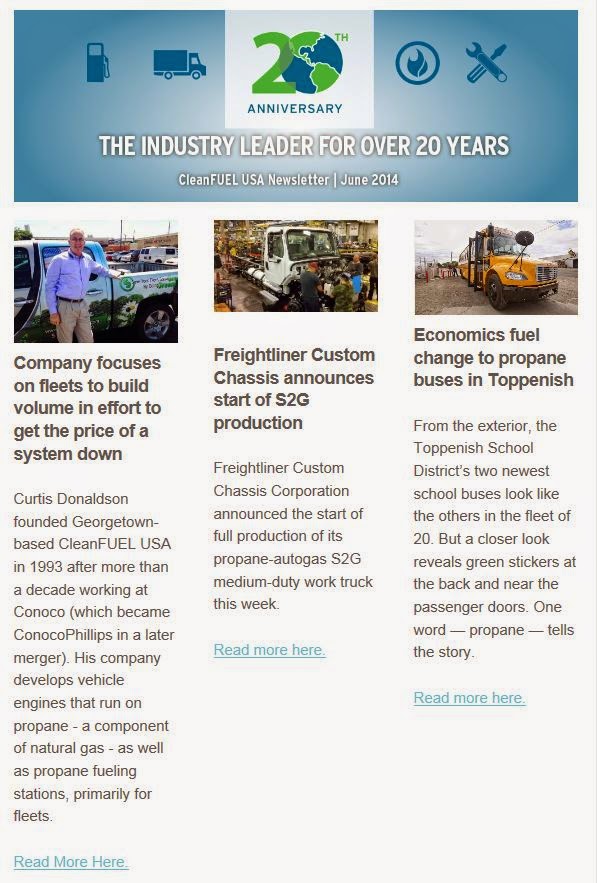
Economics fuel change to propane buses in Toppenish

Toppenish this month became one of a handful of school districts in the state to inch toward propane by adding two propane-powered school buses in an effort to fight rising diesel prices by finding a cleaner and cheaper fuel.
“We’re really anxious to try them out,” said district Transportation Director Blaine Thorington. The two vehicles could be ready for some summer school routes.
According to Educational School District 105 Transportation Coordinator Dan Payne, Toppenish is the only district in the region to have propane-powered school buses. Seattle, Camas and Tonasket school districts also have them, he said.
The two 77-passenger school buses were ordered in January 2013 from a Portland dealer, but production delays in North Carolina tested the patience of district officials, said Thorington, also a longtime Toppenish city councilman.
The first bus arrived in Toppenish two weeks ago and the second late last week. A smaller third bus, intended for physically disabled students, will arrive in six months.
The use of propane as an alternative fuel is growing nationally as school districts grapple with rising gas and diesel prices and shift toward more green initiatives. While the majority of school buses is powered by diesel fuel, alternatives like propane, biodiesel and compressed natural gas have become more popular over the years.
A gallon of propane, Thorington said, costs $1.90, significantly less than diesel, which is over $4 per gallon at several locations. Add in a 50-cent-per-gallon tax rebate and the cost of propane goes down to $1.40.
Each of the two conventional buses costs $104,000, Thorington said. In addition, the cleaner characteristics of propane — no soot residue or carbon — means fewer oil changes and maintenance inspections.
“Because of the lower maintenance costs and gas prices, they may cost less in the long run,” Payne said.
Compared with diesel-powered vehicles, propane buses run quieter, emit less pollution into the air and the cabin, and perform as well as a standard bus.
There are drawbacks, though. Propane gets less mileage per gallon than diesel and not all of the fuel can be used.
“You can’t use every drop,” Thorington said. “You can probably use 80 percent or so. Even if it says the tank is full, we can’t use (some of it) depending on the temperature and the atmosphere.”
Don’t count on taking cross-country trips with a propane bus, either. With a very limited number of refueling stations and lower mileage, taking trips out of the Valley could be a hassle.
“From Toppenish, you probably couldn’t get to Seattle and back,” said Thorington. “We’d have to find a fueling station.”
Fortunately, Bleyhl Farm Service partnered with the district on a propane fueling station in Toppenish to serve the buses.
The main objective for Toppenish is to trim fuel costs. The district has already spent more than $90,000 on diesel in the 2013-14 school year; there are no projections yet on how much the district will save, but Thorington said fuel costs will go down.
There are no immediate plans to purchase more propane-powered buses, but that could change if the rollout goes well. Ideally, Thorington said they could replace half of the district’s 20-bus diesel fleet. Read more here.
Tuesday, June 17, 2014
Propane Powered Buses for Toppenish Students

Yakima Valley diesel prices are beginning to rise above four dollars a gallon.
The Toppenish School District is planning to pay about half that with their new propane powered buses.
"After a government rebate our net costs of our propane is about a dollar-forty," says Blaine Thorington, Toppenish District Transportation Director.
The yellow buses are going green according to Thorington, who heads the Toppenish district transportation team and adds, "The exhaust coming out is clean, there's no black exhaust to have to deal with and they tell us that the oil when we dump it after an oil change is the same color, same texture as the new oil that goes in."
Thorington says these propane powered vehicles, or autogas, will be a "great barometer" for the district to see if the money they save is worth adding more.
The buses run using two large forty gallon tanks that are bolstered under the vehicle. While the high flamability of propane could be a safety issue, Blaine believes these buses are just as safe as any other in his fleet.
The large tanks are filled a couple miles away from the bus depot.
The company that builds these pump believes the fuel is much safer to handle as well, "It's a really good alternative fuel, it's used a lot in Eurpoe where they use mostly diesel, and ya i think it's a safer way to go," said Claude Zehnder, petroleum manager for Blehyl Farm Service.
Bus driver Rick Barber drove and fueled an autogas bus today, and says he is impressed and adds, "A lot more responsive, no engine noise, sounds just like a regular gas engine, nice and quite, pleanty of power to it."
Thursday, May 29, 2014
Collins Bus Corp. names new director of sales

In the new role, Leggett will work primarily with Collins Bus distributors in the western regions of the U.S. and Canada. He will be responsible for generating new vehicle sales, providing sales support to dealers and attending major industry events and dealer conferences.
Internally, Leggett will work closely with Collins Bus plant personnel to improve features on existing models and develop new products.
“I’m delighted to have Joe as part of the Collins sales staff,” said Matt Scheuler, vice president of sales and marketing. “With his industry experience and excellent reputation, I’m confident he will have an immediate impact on our organization, distributors and customers.”
Leggett comes to Collins from bus mirror manufacturer Rosco Vision Systems, where he was regional sales manager in the western U.S. He also has past industry experience with Radio Engineering Industries.
“After working with Collins Bus Corporation over the past six years in a supplier role, I’m very excited to join them as a member of their sales team,” Leggett said. “The company has a strong reputation in our industry, and I’m looking forward to working with their great team of employees, dealers and customers.” See more here.
Tuesday, May 20, 2014
New Propane-fueled Saf-T-Liner C2 in Production at Thomas Built Buses

How is it spec'ed?
Built upon the popular Saf-T-Liner C2 model, the propane autogas C2 comes complete with an Allison 2300 PTS Series transmission and a 8.0-liter liquid propane gas (LPG) engine with fully-integrated CleanFUEL USA liquid propane injection system. The 2-tank set-up has an estimated 300-mile range with a 67-gallon capacity.
It is available with a GVWR of 33,000 lbs and has a capacity of up to 81 passengers. It is also California Air Research Board-certified and exceeds EPA 2010 emissions requirements.
Why Propane?
Propane is less expensive than a gallon of gasoline or diesel on a BTU basis, plus propane fueling infrastructure costs less to install than other alternative fuels. Some schools may not even need to install propane fueling infrastructure as there are currently 2,500 public fueling locations across the United States.
Propane is also a green, clean-burning alternative fuel, with 20 percent less NOx and 12 percent less CO2 than gasoline. More than 90 percent of the propane used in the U.S. is domestically produced.
To learn more about the propane C2 or any of Thomas Built's other alternative fueled buses, visit Thomas Built's website or speak with a dealer near you. Read more here.
Monday, May 12, 2014
Thomas Built Buses honors top dealers

NASHVILLE, Tenn. — Thomas Built Buses recognized its top dealers for 2013 at its annual dealer meeting, held here on April 14.
Sonny Merryman Inc. of Evington, Va., was named Thomas Built's Dealer of the Year for the fifth time — the only dealer to have done so.
“At Thomas Built Buses, we believe in continuous improvement and innovation, two quality standards that Thomas Built employees and our dealers strive for every day,” President and CEO Kelley Platt said. “This year, we raised the standards for our dealers, and Sonny Merryman met that challenge, exemplifying continuous improvement and innovation exhibited through its commitment to customer satisfaction, exemplary training and strategic planning for the future.”
At the dealer event, President’s Club and President’s Club Platinum awards for dealership excellence were also presented to select dealers in recognition of achieving key performance indicators. A dealer must reach the President's Club Platinum level to qualify as the Dealer of the Year for its region. Here is the list of winners:
Regional Winners
• Midwest Region: Kerlin Bus Sales & Leasing Inc., Silver Lake, Ind.
• Northeast Region: W.C. Cressey & Son Inc., Kennebunk, Maine
• Southeast Region: Sonny Merryman Inc., Evington, Va.
• Western Region: The Bus Centre, Acheson, Alberta
President's Club Platinum
• American Bus Sales & Service Inc., Annapolis, Md.
• BusWest, Carson, Calif.
• Carolina Thomas LLC, Greensboro, N.C.
• Interstate Transportation Equipment Inc., Hopkins, S.C.
• Kerlin Bus Sales & Leasing Inc., Silver Lake, Ind.
• Matthews Bus Inc. Florida, Orlando, Fla.
• Mid-South Bus Center Inc., Murfreesboro, Tenn.
• Nelson’s Bus Service Inc., Whitewater, Wis.
• Sonny Merryman Inc., Evington, Va.
• The Bus Centre, Acheson, Alberta
• Transportation South Inc., Pelham, Ala.
• W.C. Cressey & Son Inc., Kennebunk, Maine
President's Club
• Autobus Thomas Inc., Drummondville, Quebec
• Lewis Bus Group Inc., Salt Lake City
• Matheny Motor Truck Co., Parkersburg, W.Va.
• Midwest Bus Sales Inc. KS/MO, Bonner Springs, Kan.
• Nesco Bus & Truck Sales Inc., Bay Shore, N.Y.
• Omaha Truck Center Inc., Omaha, Neb.
• Rohrer Bus Sales, Duncannon, Pa.
• Thomas Bus Gulf Coast GP Inc., Houston
Also at the dealer meeting, Thomas Built recognized its top dealer trainers of 2013.
Michael Stotler, Thomas Built's manager for service education and the Center for Education, presented the 2013 Thomas Dealer Trainer of the Year award to Dave Nelson of Nelson’s Bus Service in Whitewater, Wis.
Nelson, co-owner of Nelson's Bus Service and a member of the Thomas Built Train the Trainer program, was recognized for providing hands-on service maintenance and training to his customers.
The Train the Trainer program was developed to provide customers opportunities for local technician training. Thomas Built educates trainers across the country on how to provide customers with hands-on experiences and up-to-date technician information.
The program currently has 44 trainers, who conducted a total of 660 classes in 2013. Since its inception in 2009, more than 30,000 technicians have been trained through the program.
“The dealers who are involved in the Train the Trainer program are delivering in very big ways this year,” Stotler said. “Altogether, our trainers conducted approximately three classes every business day in 2013 — leaps and bounds above when we started the program in 2009. Dave Nelson is a great example of how powerful this training program can be. His commitment to training his customers and their technicians about Thomas Built Buses is a testament to his dedication.”
The winner of the Thomas Dealer Trainer of the Year award was selected from five regional winners:
• Midwest Region: Dave Nelson, Nelson’s Bus Service, Whitewater, Wis.
• Western Region: Trace Tolby, Auto Safety House, Phoenix
• Southeast Region: Ali Rampartab, Matthews Buses Florida, Orlando, Fla.
• Northeast Region: Phil Heller, Rohrer Bus, Duncannon, Pa.
• Central Region: Shawn Klein, Omaha Truck Center, Omaha, Neb.
Read more here.
Monday, April 28, 2014
School Bus Fleet Blog: Districts are in the transportation business

That bold statement, by a school board member at a Virginia district, was in a Washington Post article that I came across online last year.
The story described the school board’s decision to cut costs by more uniformly enforcing the district’s existing walking distances, which meant that about 4,000 students would no longer be provided with school bus service because they lived within the walking distances of their schools. (Those students may have been bused in the past due to construction zones or other safety concerns.)
The board member quoted above told the Washington Post that the school board’s priority is to focus resources on the classroom. While that may be true, the statement that the district is “not in the transportation business” seems misguided and even unsettling.
Multiple businesses
Yes, school districts’ primary responsibility is to educate children. But that doesn’t mean it’s their only responsibility.
Keeping kids safe and secure is equally important. In light of the 2012 Sandy Hook Elementary School massacre and other deadly school shootings, can a school district say that it is not in the safety and security business? Certainly not. Furthermore, keeping kids safe and secure extends beyond the classroom, to the playground, the school loading zone, the school bus, etc.
What about making sure that students get a good breakfast and lunch? When many kids don’t get enough to eat at home, can a school district say that it’s not in the nutrition business?
I’ve heard some school bus contractors, in making a case for districts to outsource their school bus service, use lines that are similar to what that Virginia board member said — that school districts should be in the education business, not the transportation business.
But even if a district decides to outsource all of its bus service to a private company, it’s still the district’s responsibility to make sure that the contractor is keeping the district’s students safe, properly maintaining the buses and meeting other requirements.
Pupil transportation — in other words, making sure that students can actually get to school so the teachers can teach them — is still a part of the overall service that the district provides for the public, even if someone else is running the buses for the district.
Parents’ perspective
In the case of the Virginia school district, parents did not agree that the district is “not in the transportation business.”
The Washington Post reported that about 100 parents had filed appeals because their children would not be able to ride the school bus anymore.
One local mother put the issue into harsh words when she told the newspaper, “The school system has washed its hands of the responsibility for my kids’ safety” in getting to and from school.
Clearly, parents expect school districts to be in the transportation business, and they’re not going to let that business go without a fight.
Thomas McMahon is executive editor of SCHOOL BUS FLEET. Click here to read more.
Subscribe to:
Posts (Atom)