Showing posts with label UPS. Show all posts
Wednesday, October 22, 2014
Monday, August 25, 2014
Heavy Duty Trucking: UPS Offers Keys to Fuel Efficiency
You would be hard-pressed to find a company more enthusiastically pursuing efficiency than UPS. After all, this is a company that has determined that its no-left turns policy across North America has saved almost 10 million gallons of fuel over the last 10 years.
UPS is constantly monitoring its fleet to find new ways of using alternative fuel/advanced technology to learn about how new technologies and advancements can be adapted. One result: At last count, Big Brown was running more than 3,150 alternative-fuel and advanced technology vehicles in nine different countries.
So we asked UPS to distill its fuel-saving philosophy into three bite-sized ideas:
1. Plan your route and track performance.
When planning any trip, consider the best way to get to the locations without backtracking. UPS has created a proprietary system of telematics that combines information about the behavioral with mechanical variables that affect fuel efficiency. UPS matches routes to vehicles that get better mileage at the speeds the route requires. Routes are also designed to have the minimum number of stops and starts and still be on time.
UPS also uses package-flow technologies designed to load the vans more effectively, again minimizing the time it takes a driver to find the right package and be ready to deliver it quickly. In effect, fuel efficiency starts even before the engine is turned on. This translates into fewer miles traveled, which conserves fuel and reduces emissions.
2. Avoid left turns.
For decades, UPS route planners have designed routes based on a loop of predominantly right-hand turns. Avoiding left turns conserves fuel and reduces emissions because it reduces the amount of time spent idling waiting to turn left. It is also a lot safer. (UPS actually encourages employees and other road users to avoid lefts, too.).
3. Use the vehicle with the best mileage.
Through UPS’s own modal shifting, UPS tries to match the vehicle to the needs of the routes.
And of course, in addition to using alternative fuels, it's constantly looking for ways to make its vehicles more fuel efficient regardless of the powertrain. For instance, it worked with Isuzu and Utilimaster to develop lighter-weight composite-body diesel vans that achieved a 40% increase in fuel economy over traditional aluminum vans in testing.
The company also maintains a strict anti-idle policy. Doing so has cut the amount of time delivery trucks idle by 24 minutes per driver per day, which has led to a fuel savings of $188 per driver in one year. Read more here.
Friday, August 15, 2014
UPS to Reduce Carbon Emissions By 20 Percent
UPS Inc. has set a goal to reduce the carbon intensity of its transportation operations by 20 percent in the next six years, after meeting an earlier goal three years early, the company said.
The company had set a goal in 2013 of reducing overall carbon emissions by 10 percent by 2016. After meeting that goal early, UPS now plans to reduce emissions by 20 percent by 2020.
"As a global logistics company dependent on vehicles and fuel to move nearly 17 million packages and documents a day, sustainability and growth are inextricably linked," said Scott Davis, UPS chairman and chief executive officer. "Our ability to grow our global shipping volumes and reduce total carbon emissions should be a signal to business that it is possible to do more for the environment while also serving more customers and adding more value."
UPS moved 3.9 percent more cargo last year compared to 2012 and at the same time reduced its emissions by 1.5 percent. The company operated 3,647 vehicles powered by alternative fuels, the company said.
In March, UPS announced it would invest $70 million to add 1,000 propane autogas trucks and the fueling infrastructure to support them. UPS also reduced its fuel consumption by 1.5 million gallons through route optimization initiatives.
UPS included the new goal in its "Committed to More" initiative that follows from its 2013 Sustainability Report. View more at the UPS Sustainability website here. See original article here.
Wednesday, August 6, 2014
CFUSA July Newsletter
Labels:
alternative,
autogas,
bobtail,
C2,
cleanfuel,
cleanfuelusa,
eCONNECT,
FCCC,
Freightliner,
LPG,
propane,
propane autogas,
refueling,
S2G,
UPS
Monday, June 30, 2014
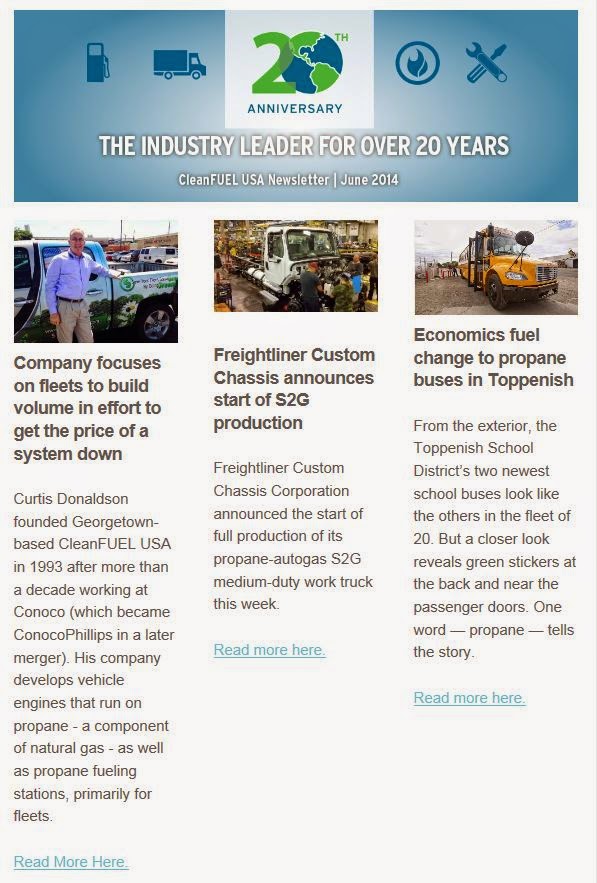
CFUSA June Newsletter
Labels:
autogas,
C2,
clean,
cleanfuel,
cleanfuelusa,
dispenser,
eCONNECT,
energy,
FCCC,
fleet,
Freightliner,
LPG,
LPI,
propane,
propane autogas,
refueling,
S2G,
school bus,
UPS,
video
Monday, June 23, 2014
A look inside the UPS refueling station build...
Watch this great video for a behind the scenes look inside the CleanFUEL USA garage as we begin to build the refueling equipment to fulfill the UPS propane autogas commitment.
Monday, June 16, 2014
Making the pitch for propane: Company focuses on fleets to build volume in effort to get the price of a system down
Via the Houston Chronicle (click for full article)
By Ryan Holeywell
Curtis Donaldson founded Georgetown-based CleanFUEL USA in 1993 after more than a decade working at Conoco (which became ConocoPhillips in a later merger). His company develops vehicle engines that run on propane - a component of natural gas - as well as propane fueling stations, primarily for fleets. It made news earlier this year when it entered a deal with UPS to supply the delivery company with 1,000 trucks and more than 50 fuel stations. He spoke with the Chronicle about the promise he sees in propane. Excerpts, condensed and edited for clarity.
Q: What prompted you to get into the propane business?
A: Conoco was looking at alternative fuels and putting them in our stations in the early 1990s. That was my project. I kind of got exposed to alternative fuels while working for a major oil company and fell in love with it. When Conoco decided not to progress beyond Denver, where the pilot project was, I left and started my own business to build dispensers.
The one thing I figured out for sure was customers aren't going to want to fill up with a device if it looks like something out of the ordinary. We build dispensers that look just like gasoline dispensers. Initially we were just making station equipment, then we migrated into making engines. Now, most of our business is on the engine side.
Q: What made you fall in love with propane?
A: I think two things. The idea of clean air quality drew me to it, and it's the utilization of a domestic resource.
Think about propane. It's in every town in America. There's no infrastructure cost to America to utilize propane. During the oil embargo (in the 1970s), propane grew from 1974 to 1981. We had 1.1 billion gallons sold by 1981, and 750,000 vehicles. I know we can do it. We've already done it once. Let's just do it again.
Q: The bulk of your customers are on the fleet side. What will it take for propane to catch on with private consumers?
A: In Europe, it's a consumer fuel. You can go to any dealership and order a propane vehicle. To get to that in the United States, we're starting with the fleets so we can build up the infrastructure of public fueling stations. It's the chicken and egg problem.
The other key is getting the volume up to get the price of the system down. Right now, based on a $10,000 propane system, who can economically justify the cost of converting? It's the fleets.
We start with fleets to build volume and infrastructure, and hopefully through building that volume, costs comes down. If we can get a system installed for $5,000, I think the consumer will start saying, "Wait a minute, I want some of that action."
Q: Why has the U.S. lagged behind the rest of the world in terms of using propane as a vehicle fuel?
A: If you look abroad, fuels in most countries are heavily taxed. In countries where propane has become prolific, the tax was waived for propane, or it's a minimal tax. In Poland about 30 percent of vehicles run on propane. Turkey's about 30 percent. Korea's about 25 percent. Australia's about 20 percent. In the U.S. we're about three-quarters of one percent.
If we could just get to 10 percent there's enough supply that we wouldn't upset supply and demand economics.
Q: Are there any downsides to using propane in a vehicle?
A: For fleets fueled in central locations, it's a no-brainer. The truck goes out and it comes back. But some trucks aren't centrally fueled. The drivers are wondering '"Where can I find propane?" I can show you where it is on a map, but how comfortable is the driver thinking he has to go out of his way?
Also, there's capital required. If they didn't put it into their budget this year, they have to put it in their budget next year. They have to spend $10,000 per vehicle to convert them. For fleets, it takes between a year and two years to pay off. But it doesn't change the fact that they need to have $10,000 per vehicle.
Q: How do you make your pitch to fleet managers?
A: If we can catch a guy who's already educated on alternative fuels, the cycle of sales is much shorter. You're just differentiating between other fuels at that point. But last week we were meeting with two fleets and it was raw education - Propane 101. We try to get them comfortable they're not jumping off a cliff with propane.
Q: If I'm a fleet manager considering alternative fuels, why should I use propane instead of compressed natural gas?
A: I'm for all energies being used.
I think the best use for CNG is in tractor-trailers and larger vehicles and mass transit. You can put a bunch of tanks on there, where the frame will support multiple tanks to get enough fuel on board.
I believe propane owns medium-duty down through light-duty. We're a liquid fuel. My pitch is we can range better, and range more closely to gasoline because we're a liquid. We're abundant. We're in every town. And the cost of infrastructure is less - about a tenth of what a CNG station costs.
By Ryan Holeywell
Curtis Donaldson founded Georgetown-based CleanFUEL USA in 1993 after more than a decade working at Conoco (which became ConocoPhillips in a later merger). His company develops vehicle engines that run on propane - a component of natural gas - as well as propane fueling stations, primarily for fleets. It made news earlier this year when it entered a deal with UPS to supply the delivery company with 1,000 trucks and more than 50 fuel stations. He spoke with the Chronicle about the promise he sees in propane. Excerpts, condensed and edited for clarity.
Q: What prompted you to get into the propane business?
The one thing I figured out for sure was customers aren't going to want to fill up with a device if it looks like something out of the ordinary. We build dispensers that look just like gasoline dispensers. Initially we were just making station equipment, then we migrated into making engines. Now, most of our business is on the engine side.
Q: What made you fall in love with propane?
A: I think two things. The idea of clean air quality drew me to it, and it's the utilization of a domestic resource.
Think about propane. It's in every town in America. There's no infrastructure cost to America to utilize propane. During the oil embargo (in the 1970s), propane grew from 1974 to 1981. We had 1.1 billion gallons sold by 1981, and 750,000 vehicles. I know we can do it. We've already done it once. Let's just do it again.
Q: The bulk of your customers are on the fleet side. What will it take for propane to catch on with private consumers?
A: In Europe, it's a consumer fuel. You can go to any dealership and order a propane vehicle. To get to that in the United States, we're starting with the fleets so we can build up the infrastructure of public fueling stations. It's the chicken and egg problem.
The other key is getting the volume up to get the price of the system down. Right now, based on a $10,000 propane system, who can economically justify the cost of converting? It's the fleets.
We start with fleets to build volume and infrastructure, and hopefully through building that volume, costs comes down. If we can get a system installed for $5,000, I think the consumer will start saying, "Wait a minute, I want some of that action."
Q: Why has the U.S. lagged behind the rest of the world in terms of using propane as a vehicle fuel?
A: If you look abroad, fuels in most countries are heavily taxed. In countries where propane has become prolific, the tax was waived for propane, or it's a minimal tax. In Poland about 30 percent of vehicles run on propane. Turkey's about 30 percent. Korea's about 25 percent. Australia's about 20 percent. In the U.S. we're about three-quarters of one percent.
If we could just get to 10 percent there's enough supply that we wouldn't upset supply and demand economics.
Q: Are there any downsides to using propane in a vehicle?
Curtis Donaldson, managing director of CleanFUEL USA, shown with a company vehicle in a Houston parking lot in 2014, founded the company in 1993 to make propane-fueled vehicles and pumps to fuel them.
Also, there's capital required. If they didn't put it into their budget this year, they have to put it in their budget next year. They have to spend $10,000 per vehicle to convert them. For fleets, it takes between a year and two years to pay off. But it doesn't change the fact that they need to have $10,000 per vehicle.
Q: How do you make your pitch to fleet managers?
A: If we can catch a guy who's already educated on alternative fuels, the cycle of sales is much shorter. You're just differentiating between other fuels at that point. But last week we were meeting with two fleets and it was raw education - Propane 101. We try to get them comfortable they're not jumping off a cliff with propane.
Q: If I'm a fleet manager considering alternative fuels, why should I use propane instead of compressed natural gas?
A: I'm for all energies being used.
I think the best use for CNG is in tractor-trailers and larger vehicles and mass transit. You can put a bunch of tanks on there, where the frame will support multiple tanks to get enough fuel on board.
I believe propane owns medium-duty down through light-duty. We're a liquid fuel. My pitch is we can range better, and range more closely to gasoline because we're a liquid. We're abundant. We're in every town. And the cost of infrastructure is less - about a tenth of what a CNG station costs.
Labels:
alternative,
autogas,
clean,
cleanfuel,
cleanfuelusa,
fleet,
LPG,
LPI,
propane,
propane autogas,
technology,
UPS
Thursday, May 1, 2014
Wednesday, April 16, 2014
UPS: Clean Delivery
Labels:
alternative,
clean,
cleanfuelusa,
FCCC,
fleet,
Freightliner,
LPG,
propane,
propane autogas,
station,
UPS,
vehicles
Tuesday, April 1, 2014
CleanFUEL USA March Newsletter
Labels:
cleanfuel,
cleanfuelusa,
dispenser,
FCCC,
fleet,
Freightliner,
MT45,
NPGA,
NTEA,
propane,
propane autogas,
school bus,
UPS
Monday, March 24, 2014
Webinar Covers Freightliner Custom Chassis MT-45/55 Powered by Autogas
This
new webinar provides in-depth background on the propane-autogas chassis,
engine, and injection system that are being used in the 1,000 UPS delivery
trucks soon to hit the road. Reps from Freightliner Custom Chassis Corp.,
CleanFUEL USA, and Powertrain Integration discuss their part in the project.
Click here to access the webinar and here to access the presentation deck.
Wednesday, March 19, 2014
Green vs. Green: Winners but no Losers
That trucking is greening ever faster was exceedingly evident to me while in Indy attending numerous news conferences and taking in a dizzying array of booth displays promoting the environmental bona fides of all sorts of truck equipment at the annual NTEA Work Truck Show.
In making the rounds at that sprawling event, what came across as clearly as a brilliant blue sky is just what a Herculean task it must be for fleet owners to determine exactly which green powertrain solutions and equipment options will best fit truck duty cycles and applications to both cut operating costs and trim carbon foot prints.
Speakers at the Green Truck Summit that accompanied the show delved into the nitty-gritty aspects of specific alternatives to running on diesel or gasoline, but nothing said there left me thinking any more than I had before that trucking will ever settle on one fuel to drive it all.
What I heard about this alternative fuel vs. that alternative fuel brought to mind the wordless comic strip “Spy vs. Spy” (which Mad magazine began running in 1961) that illustrates the antics of two spies who are identical-- except one is dressed in black and the other in white— and locked in ceaseless seesaw combat.
Much like the comic battles waged in Spy vs. Spy, it's a safe bet that trucking's Green vs. Green storyline will never yield a clear winner...
Of course, there are already several more than two players in the alt-fuel game (Biodiesel, Ethanol, CNG, LNG, LPG, Hydraulic Hybrid, Hybrid Electric, All Electric) with others expected to join in the pitch for fleet loyalties in the near (such as DME) and the longer term (such as Hydrogen).
Summit speaker Doyle Sumrall, NTEA managing director, perhaps said it best. “Fleet approaches to selecting alternative fuels remain eclectic,” he remarked. “Natural gas remains strong, but so do others.”
The point is the choices by which a fleet can be fueled to be green and save green are growing. And not even the proponents of any given alternative fuel suggest that their pony alone will win all the stakes.
While natural gas (in both its CNG and LNG forms) will arguably remain king of trucking’s green hill for some time to come, that other gaseous fuel propane autogas (LPG for short) made an awfully big splash at the show with the announcement by UPS that it plans to invest some $70 million to bring propane power into its U.S. fleet.
That investment will cover the purchase of 1,000 of its iconic “package car” medium-duty delivery trucks powered by propane autogas and the installation of an initial 50 LPG fueling stations at UPS-owned sites here.
Per UPS, the move “benefits from propane autogas’ wide availability as a result of increased natural gas production in the U.S. (LPG is a byproduct of natural gas), and there is more price stability with the accessible supply.”

Prototype UPS package car fueled by propane autogas on display at NTEA Work Truck Show, which was held March 4-7 in Indianapolis
Michael G. Britt, Sr., UPS’ director of Maintenance & Engineering International Operations, said the LPG-fueled step vans, to be built by Freightliner Custom Chassis Corp. (FCCC) will replace older gasoline- and diesel-powered units used largely in rural parts of Louisiana and Oklahoma. He added that propane use in other states is pending.
Later on, I asked Bryan Henke, FCCC’s manager—product marketing, for an OEM’s perspective on how the burgeoning market for alternatively fueled trucks may shake out.
Noting that FCCC currently builds trucks powered by diesel, gasoline, CNG and LNG and has prior experience with hybrid-electric powertrains, Henke said the company prides itself on “being a single-source [vehicle] provider based on the fleet’s fuel of choice.
“All fleets want to save money,” he continued. “But the [green] decision has to take in infrastructure, maintenance etc. You are not buying just the fuel. It all comes down to evaluating which power choice will best fit a fleet’s specific needs.”
Perhaps then, when it comes to green vs. green, there will be no winner— but also no losers. Full article here.
In making the rounds at that sprawling event, what came across as clearly as a brilliant blue sky is just what a Herculean task it must be for fleet owners to determine exactly which green powertrain solutions and equipment options will best fit truck duty cycles and applications to both cut operating costs and trim carbon foot prints.
Speakers at the Green Truck Summit that accompanied the show delved into the nitty-gritty aspects of specific alternatives to running on diesel or gasoline, but nothing said there left me thinking any more than I had before that trucking will ever settle on one fuel to drive it all.
What I heard about this alternative fuel vs. that alternative fuel brought to mind the wordless comic strip “Spy vs. Spy” (which Mad magazine began running in 1961) that illustrates the antics of two spies who are identical-- except one is dressed in black and the other in white— and locked in ceaseless seesaw combat.
Much like the comic battles waged in Spy vs. Spy, it's a safe bet that trucking's Green vs. Green storyline will never yield a clear winner...
Of course, there are already several more than two players in the alt-fuel game (Biodiesel, Ethanol, CNG, LNG, LPG, Hydraulic Hybrid, Hybrid Electric, All Electric) with others expected to join in the pitch for fleet loyalties in the near (such as DME) and the longer term (such as Hydrogen).
Summit speaker Doyle Sumrall, NTEA managing director, perhaps said it best. “Fleet approaches to selecting alternative fuels remain eclectic,” he remarked. “Natural gas remains strong, but so do others.”
The point is the choices by which a fleet can be fueled to be green and save green are growing. And not even the proponents of any given alternative fuel suggest that their pony alone will win all the stakes.
While natural gas (in both its CNG and LNG forms) will arguably remain king of trucking’s green hill for some time to come, that other gaseous fuel propane autogas (LPG for short) made an awfully big splash at the show with the announcement by UPS that it plans to invest some $70 million to bring propane power into its U.S. fleet.
That investment will cover the purchase of 1,000 of its iconic “package car” medium-duty delivery trucks powered by propane autogas and the installation of an initial 50 LPG fueling stations at UPS-owned sites here.
Per UPS, the move “benefits from propane autogas’ wide availability as a result of increased natural gas production in the U.S. (LPG is a byproduct of natural gas), and there is more price stability with the accessible supply.”
Prototype UPS package car fueled by propane autogas on display at NTEA Work Truck Show, which was held March 4-7 in Indianapolis
Michael G. Britt, Sr., UPS’ director of Maintenance & Engineering International Operations, said the LPG-fueled step vans, to be built by Freightliner Custom Chassis Corp. (FCCC) will replace older gasoline- and diesel-powered units used largely in rural parts of Louisiana and Oklahoma. He added that propane use in other states is pending.
Later on, I asked Bryan Henke, FCCC’s manager—product marketing, for an OEM’s perspective on how the burgeoning market for alternatively fueled trucks may shake out.
Noting that FCCC currently builds trucks powered by diesel, gasoline, CNG and LNG and has prior experience with hybrid-electric powertrains, Henke said the company prides itself on “being a single-source [vehicle] provider based on the fleet’s fuel of choice.
“All fleets want to save money,” he continued. “But the [green] decision has to take in infrastructure, maintenance etc. You are not buying just the fuel. It all comes down to evaluating which power choice will best fit a fleet’s specific needs.”
Perhaps then, when it comes to green vs. green, there will be no winner— but also no losers. Full article here.
Tuesday, March 18, 2014
Work Truck Show 2014 Success Reflects Rebounding Industry
FARMINGTON HILLS, Mich., March 17, 2014 /PRNewswire/ -- Indianapolis, IN, was once again the center of the vocational truck universe as more than 10,000 industry professionals gathered for The Work Truck Show® 2014, March 5–7 at the Indiana Convention Center. The event featured significant new product introductions, a day-and-a-half Green Truck Summit, more than 60 educational sessions, and a record number of ride-and-drive opportunities.
"The success of this year's Work Truck Show is reflective of the slow but steady growth our industry is currently enjoying," says Steve Carey, NTEA executive director. "Vocational trucks and equipment are the tools that millions of people rely on every day to get their jobs done. As the economy improves and budget restrictions ease, vocational fleets are able to start replacing older equipment. The Work Truck Show offers the best opportunity to see and try the latest products, get questions answered and develop a better understanding of industry trends, all in one place at one time."
The Work Truck Show is produced annually by NTEA – The Association for the Work Truck Industry. The event's educational conference, including the popular Green Truck Summit, kicked off on March 4. Altogether, 10,160 people attended The Work Truck Show 2014, making it one of the best-attended events in NTEA history.
More than 100 new products were introduced at the Show, including the 2016 Ford F-650 and F-750, Mitsubishi Fuso Truck of America's 2015 Canter FE130 cabover work truck, and many technology developments designed to improve work truck fuel utilization. Several companies also used the Show as a platform to announce new partnerships and technology adoptions. For example, UPS and the Propane Education & Research Council (PERC) announced that UPS is buying 1,000 propane delivery trucks and building 50 fueling stations for a total investment of approximately $70 million.
One of the hottest areas in the work truck industry in recent years has been the development of sustainable technology. This trend has driven the ongoing popularity of the Green Truck Summit and the Green Truck Ride-and-Drive at The Work Truck Show. At the 2014 event, attendees had the opportunity to test-drive nearly 30 "green" vehicles for themselves between the Green Truck Ride-and-Drive and the new PERC-sponsored Propane Autogas Ride & Drive. Read more here.
"The success of this year's Work Truck Show is reflective of the slow but steady growth our industry is currently enjoying," says Steve Carey, NTEA executive director. "Vocational trucks and equipment are the tools that millions of people rely on every day to get their jobs done. As the economy improves and budget restrictions ease, vocational fleets are able to start replacing older equipment. The Work Truck Show offers the best opportunity to see and try the latest products, get questions answered and develop a better understanding of industry trends, all in one place at one time."
The Work Truck Show is produced annually by NTEA – The Association for the Work Truck Industry. The event's educational conference, including the popular Green Truck Summit, kicked off on March 4. Altogether, 10,160 people attended The Work Truck Show 2014, making it one of the best-attended events in NTEA history.
More than 100 new products were introduced at the Show, including the 2016 Ford F-650 and F-750, Mitsubishi Fuso Truck of America's 2015 Canter FE130 cabover work truck, and many technology developments designed to improve work truck fuel utilization. Several companies also used the Show as a platform to announce new partnerships and technology adoptions. For example, UPS and the Propane Education & Research Council (PERC) announced that UPS is buying 1,000 propane delivery trucks and building 50 fueling stations for a total investment of approximately $70 million.
One of the hottest areas in the work truck industry in recent years has been the development of sustainable technology. This trend has driven the ongoing popularity of the Green Truck Summit and the Green Truck Ride-and-Drive at The Work Truck Show. At the 2014 event, attendees had the opportunity to test-drive nearly 30 "green" vehicles for themselves between the Green Truck Ride-and-Drive and the new PERC-sponsored Propane Autogas Ride & Drive. Read more here.
Labels:
clean,
cleanfuel,
cleanfuelusa,
energy,
fleet,
green fleet,
LPG,
LPI,
NTEA,
propane,
propane autogas,
UPS
Saturday, March 15, 2014
UPS delivers a boost to propane as vehicle fuel
Most people - especially Texans - know propane as the fuel source that allows them to fire up a backyard barbecue in seconds.
Now it's also heating up as an alternative motor fuel, as companies with vehicle fleets embrace its lower costs and smaller environmental footprint relative to gasoline or diesel.
Shipping company UPS announced plans this month to spend $70 mil- lion on 1,000 propane-fueled vehicles and 50 refueling stations in the United States, where the company operates about 77,000 ground vehicles.
Other big companies also have added propane to their fuel mix.
Airport transportation service SuperShuttle touted its propane vehicles earlier this year, saying its 160 propane vehicles, including 30 in Houston, are reducing fuel costs by as much as 60 percent.
Last year, DirecTV announced plans to include more propane-fueled vans in its repair and installation fleet.
And in recent months, school districts in Texas, Arizona and Montana have announced the purchase of propane-powered buses.
The increased attention on propane, also known as autogas or liquefied petroleum gas, comes as the country enjoys a boom in domestic energy production.
Propane is a byproduct of natural gas processing and crude oil refining. Primarily used for home heating and cooking, transportation represents just 2 percent of the fuel's domestic use, according to federal estimates. But that may be changing.
"It's starting to make a lot more sense, given the boom in domestic production," said Roy Willis, CEO of the Propane Education & Research Council, an industry group.
It is generally less expensive than gasoline, according to the Department of Energy, and emits fewer air pollutants and greenhouse gases.
The cleaner burn also extends engine life, advocates say.
"If you've got longer engine wear, the economics of that power system really goes to the bottom line in a beneficial way," Willis said.
Still, when it comes to alternative fuels for vehicles, compressed natural gas typically generates more buzz than propane. Texas energy magnate T. Boone Pickens is a cheerleader for CNG; propane has no such iconic champion.
Small players
And some of the world's largest companies produce and supply natural gas, while propane typically draws smaller players.
UPS officials say they were motivated to consider propane because of a desire to make a positive environmental impact, and also to save money.
They say the new vehicles will collectively travel more than 25 million miles and replace 3.5 million gallons of gasoline and diesel annually.
Mike Casteel, director of fleet procurement for UPS, says the company expects to pay $1.25 to $1.50 per gallon less for propane than for gasoline. A gallon of propane will only take a truck about 75 percent to 90 percent as far as a gallon of gasoline, but the savings still can amount to $1 per gallon or more. He also said the company believes growing domestic energy supplies will keep long-term propane prices stable.
Cost of fueling stations
UPS believes propane-powered vehicles could be more economical in some situations than compressed natural gas. Both fuels are less expensive than gasoline, but Casteel said propane fueling stations are cheaper to build than CNG stations.
It costs $37,000 to $175,000 to build a propane station, according to the Department of Energy, while a CNG station can cost millions of dollars.
Casteel says that price difference is especially significant for UPS, since it plans to use the 1,000 new propane vehicles in rural locations in Oklahoma, Louisiana and elsewhere.
In a big city hub with a large UPS fleet, a CNG facility might have made sense. Only 20-40 vehicles will use each of the new propane facilities, Casteel said.
Propane stations are simpler, Casteel said, partly because the fuel is stored in above-ground tanks and delivered by truck, so it doesn't require pipelines.
Rhea Courtney Bozic, principal of Clean Fuels Consulting, a New York company that helps companies plan alternative fuel fleets, said a growing number of manufacturers have been producing the components needed for propane vehicles, which might be helping to generate interest in the fuel. And the industry has improved its marketing of propane as a transportation fuel, she said.
Still, despite the move by UPS and others, propane vehicles represent just a fraction of vehicles on U.S. roads - about 140,000 of 250 million, according to the industry and the Energy Department.
Larger fuel tanks
The technology isn't perfect. Propane has slightly less energy content than gasoline. That means vehicles need more fuel and larger tanks to go the same range, according to the Environmental Protection Agency.
Whether purchased new or converted to use the fuel, propane-powered vehicles - like most vehicles running on alternative fuels - can cost thousands of dollars more than their gasoline equivalents. And cold weather earlier this year caused some propane users to suffer from spikes in their fuel costs.
Willis of the propane council said companies that have big fleets of propane vehicles tend to have long-term fuel contracts that insulate them from short-term price fluctuation.
"The cost of the fuel for fleets is very predictable," he said. Read more here.
Now it's also heating up as an alternative motor fuel, as companies with vehicle fleets embrace its lower costs and smaller environmental footprint relative to gasoline or diesel.
Shipping company UPS announced plans this month to spend $70 mil- lion on 1,000 propane-fueled vehicles and 50 refueling stations in the United States, where the company operates about 77,000 ground vehicles.
Other big companies also have added propane to their fuel mix.
Airport transportation service SuperShuttle touted its propane vehicles earlier this year, saying its 160 propane vehicles, including 30 in Houston, are reducing fuel costs by as much as 60 percent.
Last year, DirecTV announced plans to include more propane-fueled vans in its repair and installation fleet.
And in recent months, school districts in Texas, Arizona and Montana have announced the purchase of propane-powered buses.
The increased attention on propane, also known as autogas or liquefied petroleum gas, comes as the country enjoys a boom in domestic energy production.
Propane is a byproduct of natural gas processing and crude oil refining. Primarily used for home heating and cooking, transportation represents just 2 percent of the fuel's domestic use, according to federal estimates. But that may be changing.
"It's starting to make a lot more sense, given the boom in domestic production," said Roy Willis, CEO of the Propane Education & Research Council, an industry group.
It is generally less expensive than gasoline, according to the Department of Energy, and emits fewer air pollutants and greenhouse gases.
The cleaner burn also extends engine life, advocates say.
"If you've got longer engine wear, the economics of that power system really goes to the bottom line in a beneficial way," Willis said.
Still, when it comes to alternative fuels for vehicles, compressed natural gas typically generates more buzz than propane. Texas energy magnate T. Boone Pickens is a cheerleader for CNG; propane has no such iconic champion.
Small players
And some of the world's largest companies produce and supply natural gas, while propane typically draws smaller players.
UPS officials say they were motivated to consider propane because of a desire to make a positive environmental impact, and also to save money.
They say the new vehicles will collectively travel more than 25 million miles and replace 3.5 million gallons of gasoline and diesel annually.
Mike Casteel, director of fleet procurement for UPS, says the company expects to pay $1.25 to $1.50 per gallon less for propane than for gasoline. A gallon of propane will only take a truck about 75 percent to 90 percent as far as a gallon of gasoline, but the savings still can amount to $1 per gallon or more. He also said the company believes growing domestic energy supplies will keep long-term propane prices stable.
Cost of fueling stations
UPS believes propane-powered vehicles could be more economical in some situations than compressed natural gas. Both fuels are less expensive than gasoline, but Casteel said propane fueling stations are cheaper to build than CNG stations.
It costs $37,000 to $175,000 to build a propane station, according to the Department of Energy, while a CNG station can cost millions of dollars.
Casteel says that price difference is especially significant for UPS, since it plans to use the 1,000 new propane vehicles in rural locations in Oklahoma, Louisiana and elsewhere.
In a big city hub with a large UPS fleet, a CNG facility might have made sense. Only 20-40 vehicles will use each of the new propane facilities, Casteel said.
Propane stations are simpler, Casteel said, partly because the fuel is stored in above-ground tanks and delivered by truck, so it doesn't require pipelines.
Rhea Courtney Bozic, principal of Clean Fuels Consulting, a New York company that helps companies plan alternative fuel fleets, said a growing number of manufacturers have been producing the components needed for propane vehicles, which might be helping to generate interest in the fuel. And the industry has improved its marketing of propane as a transportation fuel, she said.
Still, despite the move by UPS and others, propane vehicles represent just a fraction of vehicles on U.S. roads - about 140,000 of 250 million, according to the industry and the Energy Department.
Larger fuel tanks
The technology isn't perfect. Propane has slightly less energy content than gasoline. That means vehicles need more fuel and larger tanks to go the same range, according to the Environmental Protection Agency.
Whether purchased new or converted to use the fuel, propane-powered vehicles - like most vehicles running on alternative fuels - can cost thousands of dollars more than their gasoline equivalents. And cold weather earlier this year caused some propane users to suffer from spikes in their fuel costs.
Willis of the propane council said companies that have big fleets of propane vehicles tend to have long-term fuel contracts that insulate them from short-term price fluctuation.
"The cost of the fuel for fleets is very predictable," he said. Read more here.
Labels:
clean,
cleanfuel,
cleanfuelusa,
energy,
fleet,
green fleet,
LPG,
LPI,
NTEA,
propane,
propane autogas,
UPS
Wednesday, March 5, 2014
Bloomberg TV: UPS Turns to Propane in $70M Alternate-Energy Push
Today, United Parcel Service Inc. (UPS) announced it will spend $70 million to buy 1,000 delivery trucks powered by propane and build 50 fueling stations as it expands one of the largest private alternative-energy fleets in the U.S.
Check out this great video on Bloomberg Television’s “In The Loop” by chief national correspondent, Carol Massar examining the $70 million investment in propane-fueled vehicles by UPS as it diversifies its delivery fleet with alternative-fuel vehicles.
Labels:
alternative,
energy,
fleet,
fuel,
propane,
transportation,
UPS,
video
UPS® Utilizing CleanFUEL USA Liquid Propane Injection Systems and Propane Autogas Refueling Stations for Delivery Truck Fleet Installation
INDIANAPOLIS, IN – NATIONAL TRUCK EQUIPMENT (NTEA) WORK TRUCK SHOW ––
March 5, 2014 – CleanFUEL USA, an industry leader in propane autogas technology, today announced that UPS® will be using CleanFUEL USA’s Liquid Propane Injection (LPI) system in its planned purchase of 1,000 propane autogas package delivery trucks, as
well
as multiple
refueling stations across
the United States.
“The UPS announcement marks one of the single
largest alternative fuel vehicle purchases
in the package delivery industry, and we are thrilled
to provide CleanFUEL USA
equipment to help the company invest in an environmentally
friendly energy source and realize cost savings
with American-made propane autogas,”
said Curtis
Donaldson, founder and managing partner of
CleanFUEL USA.
The UPS delivery truck is based on a new CleanFUEL USA offering, the Freightliner Custom Chassis MT-45 walk-in van with CleanFUEL USA LPI system and 6.0L engine provided by Powertrain Integration. The truck will be on display in the Propane Education and Research
Council (PERC) booth, #5103. The MT-45/55 application is CARB and EPA certified.
As well today, CleanFUEL USA announced its new vehicle offering, the GMC C2500 pick-
up truck equipped with 6.0L engine and CleanFUEL USA LPI system, which is proven to
be one of the most technologically advanced propane autogas systems available in the United States. This recently updated system includes a simplified design and new fuel rails for reduced weight, yielding less heat absorption and promoting the liquid phase of the
propane injection process. The new vehicle offering is on display in booth #5291, along with CleanFUEL USA’s CFT PRO 6100 propane autogas refueling dispenser.
“There is a gap in the light-duty market segment in that a large number of fleets are using these vehicles in day-to-day operations and are looking for an alternative to
gasoline, diesel and natural gas. Our 6.0L offerings help these fleets realize the benefits of propane autogas
while experiencing no loss
in
power or payload,” said Wayne Moore, COO of CleanFUEL USA.
CleanFUEL USA is expected to soon gain EPA certification for a vast number of General
Motors (GM) 6.0L light-duty applications, including GM’s 2500/3500 pick-up trucks and cargo vans.
Propane autogas is the third most widely used transportation fuel globally, and is
proven to be the most attractive option from an economic
and environmental
standpoint. Already the leading alternative fuel in the United States, propane autogas costs an average
of 30 to 40 percent less than gasoline, and up to 50 percent less than diesel. The lowest greenhouse gas emitting fuel, vehicles fueled by propane autogas emit 20 percent less nitrogen oxide, 60 percent less carbon monoxide and up to 25 percent less greenhouse gases.
Labels:
alternative,
autogas,
CARB,
emissions,
EPA,
fleet,
GMC,
green fleet,
LPG,
LPI,
NTEA,
propane,
propane autogas,
technology,
transportation,
truck,
UL propane dispenser,
UPS,
vehicles
Subscribe to:
Posts (Atom)