Showing posts with label fleet. Show all posts

Wednesday, July 16, 2014

CleanFUEL USA Meets Fleet Industry Demand with New Products in Full Production


Company’s Liquid Propane Injection System Powers Freightliner Custom Chassis S2G Medium-Duty Truck and Thomas Built C2 School Bus

GEORGETOWN, TX –– July 16, 2014 – CleanFUEL USA, the industry leader in propane autogas fleets and fueling infrastructure, today announced full production of two prominent product offerings powered by its Liquid Propane Injection (LPI) system, the Freightliner Custom Chassis S2G medium-duty truck and the Thomas Built C2 school bus. The CleanFUEL USA LPI propane autogas fuel system is technologically advanced, fully integrated and factory-installed, requiring no aftermarket modifications, for seamless integration and consistent quality. Both vehicles are EPA and CARB certified.

“We are ecstatic that the S2G and C2 are in full production, as demand is strong in the fleet industry for propane-powered solutions that meet these two vehicles’ market needs,” said Curtis Donaldson, founder and managing director of CleanFUEL USA. “With a significant order bank and ever-increasing customer interest, the potential for both products is huge.”

The S2G truck pairs FCCC’s popular S2 chassis with the only factory-installed propane autogas engine available to the medium-duty truck market. The FCCC S2G was designed with input from fleet managers and body manufacturers on component placement, PTO accessibility and electrical interfaces.

The Thomas Built Saf-T-Liner C2 school bus offers exceptional power and quiet operation, and is available with popular options like wheelchair lifts and air-conditioning. Today, one in three American children who ride a bus to school or an activity rides a Thomas.

Both products are powered by an 8-liter purpose-built engine by Powertrain Integration and an Allison 2300 automatic transmission with PTO provision, providing reliability and durability. The engine offers 495 ft-lbs of torque at 3100 rpm and 339 horsepower at 4100 rpm, and both are backed by warranties and service programs.

More information on the S2G can be found here and the C2 here.


About CleanFUEL USA:

CleanFUEL USA, the nation’s first developer of liquid propane fuel injection systems, is a leading manufacturer of propane autogas dispensers and refueling infrastructure. Headquartered in Georgetown, Texas, with an engineering division in Wixom, Mich., CleanFUEL USA celebrates more than 20 years of innovation. Setting industry standards with a complete alternative fuel solution, CleanFUEL USA products offer unsurpassed economic and environmental advantages. Learn more at www.cleanfuelusa.com.

Connect on Twitter (@CleanFUELUSA), Facebook (facebook.com/CleanFUELUSA), YouTube (youtube.com/CleanFuelUSA1) and LinkedIn (linkedin.com/company/cleanfuel-usa).

###

Contacts

Gina Manassero
(512) 553-2387

Crystelle Markley
CleanFUEL USA
(512) 864-0300

Friday, July 11, 2014

CleanFuel USA; Bringing Out the Best in Fuel Technology

A recent invention is about to bring a revolution in the way fleet managers used to monitor and control fuel transactions. This invention has been carried out by one of the largest fuel management systems suppliers from USA, the CleanFuel.

By the implementation of this fuel management system, fuel monitoring will be made simpler and much economical. This new system will allow real time monitoring of fuel and will be able to connect with numerous points online as well. Automated logs can be saved, downloaded or emailed having complete reports about fuel dispatch. Remote access of fuel tanks and dispensers has been never been so easy before.

Curtis Donaldson, who is the founder of CleanFuel, USA, explains this technology as an economical and innovative approach to fuel management which comprises of state of the art software technology the world of fuel management has ever seen.

This latest fuel management system has some of the most promising features which are listed below:
  • Real time monitoring of fuel transaction
  • Economical and affordable
  • Complete online management
  • Easy to understand and use interface
  • Remotely accessible via smart devices such as phones, tablets, laptops
  • Online storage of data to cloud services
  • Improved security features
  • Can also be used to record and monitor actual mileage costs
Apart from these features the basic features are always there for ease of use such as a keypad for data entry, a memory card slot, RFID, etc. The device is tested and approved to be used in hazardous areas. Alongside the management system, CleanFuel will also be featuring a high tech flow meter which it terms to be the highly accurate flow meter till date.

CleanFuel USA is based in Georgetown, Texas and has been involved in fuel equipment engineering for more than 20 years. Read more here.

Monday, June 16, 2014

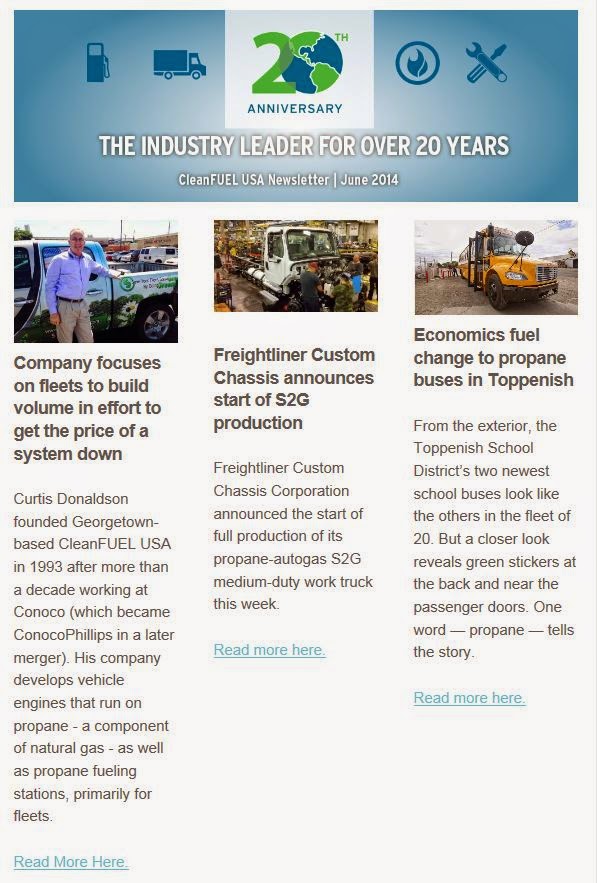
Making the pitch for propane: Company focuses on fleets to build volume in effort to get the price of a system down

Via the Houston Chronicle (click for full article)
By Ryan Holeywell

Curtis Donaldson founded Georgetown-based CleanFUEL USA in 1993 after more than a decade working at Conoco (which became ConocoPhillips in a later merger). His company develops vehicle engines that run on propane - a component of natural gas - as well as propane fueling stations, primarily for fleets. It made news earlier this year when it entered a deal with UPS to supply the delivery company with 1,000 trucks and more than 50 fuel stations. He spoke with the Chronicle about the promise he sees in propane. Excerpts, condensed and edited for clarity.

Q: What prompted you to get into the propane business?
A: Conoco was looking at alternative fuels and putting them in our stations in the early 1990s. That was my project. I kind of got exposed to alternative fuels while working for a major oil company and fell in love with it. When Conoco decided not to progress beyond Denver, where the pilot project was, I left and started my own business to build dispensers.
The one thing I figured out for sure was customers aren't going to want to fill up with a device if it looks like something out of the ordinary. We build dispensers that look just like gasoline dispensers. Initially we were just making station equipment, then we migrated into making engines. Now, most of our business is on the engine side.
Q: What made you fall in love with propane?
A: I think two things. The idea of clean air quality drew me to it, and it's the utilization of a domestic resource.
Think about propane. It's in every town in America. There's no infrastructure cost to America to utilize propane. During the oil embargo (in the 1970s), propane grew from 1974 to 1981. We had 1.1 billion gallons sold by 1981, and 750,000 vehicles. I know we can do it. We've already done it once. Let's just do it again.
Q: The bulk of your customers are on the fleet side. What will it take for propane to catch on with private consumers?
A: In Europe, it's a consumer fuel. You can go to any dealership and order a propane vehicle. To get to that in the United States, we're starting with the fleets so we can build up the infrastructure of public fueling stations. It's the chicken and egg problem.
The other key is getting the volume up to get the price of the system down. Right now, based on a $10,000 propane system, who can economically justify the cost of converting? It's the fleets.
We start with fleets to build volume and infrastructure, and hopefully through building that volume, costs comes down. If we can get a system installed for $5,000, I think the consumer will start saying, "Wait a minute, I want some of that action."
Q: Why has the U.S. lagged behind the rest of the world in terms of using propane as a vehicle fuel?
A: If you look abroad, fuels in most countries are heavily taxed. In countries where propane has become prolific, the tax was waived for propane, or it's a minimal tax. In Poland about 30 percent of vehicles run on propane. Turkey's about 30 percent. Korea's about 25 percent. Australia's about 20 percent. In the U.S. we're about three-quarters of one percent.
 If we could just get to 10 percent there's enough supply that we wouldn't upset supply and demand economics.
Q: Are there any downsides to using propane in a vehicle?
Curtis Donaldson, managing director of CleanFUEL USA, shown with a company vehicle in a Houston parking lot in 2014, founded the company in 1993 to make propane-fueled vehicles and pumps to fuel them.
A: For fleets fueled in central locations, it's a no-brainer. The truck goes out and it comes back. But some trucks aren't centrally fueled. The drivers are wondering '"Where can I find propane?" I can show you where it is on a map, but how comfortable is the driver thinking he has to go out of his way?
Also, there's capital required. If they didn't put it into their budget this year, they have to put it in their budget next year. They have to spend $10,000 per vehicle to convert them. For fleets, it takes between a year and two years to pay off. But it doesn't change the fact that they need to have $10,000 per vehicle.
Q: How do you make your pitch to fleet managers?
A: If we can catch a guy who's already educated on alternative fuels, the cycle of sales is much shorter. You're just differentiating between other fuels at that point. But last week we were meeting with two fleets and it was raw education - Propane 101. We try to get them comfortable they're not jumping off a cliff with propane.
Q: If I'm a fleet manager considering alternative fuels, why should I use propane instead of compressed natural gas?
A: I'm for all energies being used.
I think the best use for CNG is in tractor-trailers and larger vehicles and mass transit. You can put a bunch of tanks on there, where the frame will support multiple tanks to get enough fuel on board.
I believe propane owns medium-duty down through light-duty. We're a liquid fuel. My pitch is we can range better, and range more closely to gasoline because we're a liquid. We're abundant. We're in every town. And the cost of infrastructure is less - about a tenth of what a CNG station costs.